LOVR-OOP-Graphics-Engine
Particle Class
Description
Particleobjects act as a fixed point where soft particles are emitted from given a velocity. Emitted particles behave as they would in the normal world, meaning they act as physical points affected by gravity and optional collisions. Furthermore,Particleobjects have options for how long they last, a wait time for how long to wait before spawning a new particle, and how their transparency and size changes over time, soft/volumetric light options, and more. More information on the soft particle system can be found here.
Understanding Alpha and Scale Range:
- Each
Particleobject has a set of interesting options for modifying the appearance of emitted particles over time. - The
alphaRangeof aParticleobject represents how the opacity of emitted particles changes over it’s lifetime. The best way to think about a number range is as graph with an x and y axis. 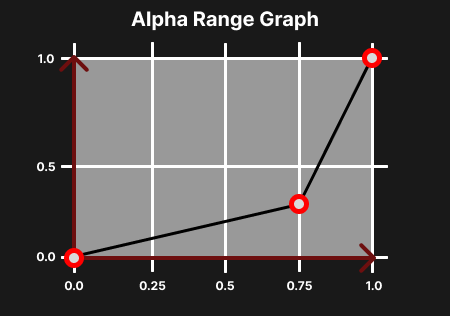
- The x axis represents the lifetime of the particle represented as a percent, while the y axis represents the property being modified, which in this case is the opacity of the particle.
- Notice the dots placed on the graph. As the current lifetime moves along these graphs, the final opacity of the particle will follow the lines between these dots. In this particular graph, the opacity of the particle will start at 0, then as it gets to 75% of the lifetime of the particle, it will increase slightly, then move up to 1.0 as the lifetime reaches 100%.
- You can set an
alphaRangenumber usingsetAlphaRangeIndex(time [number], value [number]), wheretimeis a number from 0 to 1 representing the lifetime, andvaluerepresents another number from 0 to 1 representing the opacity at that current lifetime number. - This same property applies to
setScaleRangeIndex(time [number], value [vector3]), wherevalueis alovr vector3instead of a number. - Keep in mind that the values for lifetime 0 for both
alphaRangeandscaleRangeare automatically set to 1 and (1, 1, 1), and for lifetime 1, 0 and (0, 0, 0). So by default every emitted particle will scale down and become more transparent over time.
Understanding Directional Force Range:
- When a new particle is emitted, it will automatically have an initial force applied to it. This force is dictated by
directionalForceRange, which represents a random directional force the particle will be sent in. directionalForceRangeis a table that includes variablesxRange,yRange, andzRange. All of these variables arelovr vector2’s.- When a new particle is emitted, it’s initial directional force will pick a random number between the x and y value of each xyz range. So for example, if I have
xRangeequal to alovr vector2with (-20, 20), every new particle will have it’s x initial directional force be a random number between -20 and 20. - If
useLookVectorof theParticleobject is set to true, then this initial directional force will be based on the rotation of theParticleobject. - Keep in mind that the directional force for each emitted particle is affected by the
frictionof theParticleobject!
Properties of a Model object - Extended from the Node class
typestring [default = “Particle”]: The class type of the object.Appearance Properties:
diffuseMaplovr texture: The diffuse texture for the Model.enabledbool [default = true]: Whether new particles are created on each update call.faceCamerabool [default = true]: Whether particles are always oriented to face the camera.hasDepthTestbool [default = true]: Whether particles appear in front of objects blocking them.hasShadowCastingsbool [default = true]: Whether shadows from a light source can be casted onto particles.brightnessnumber [default = 1]: How bright the particle is when being rendered.Physics Properties:
gravitynumber [default = 30]: The force of gravity enacted on the particle.frictionnumber [default = 0.99]: The amount of friction that dampens thedirectionalForceRangeof each particle.timeStepnumber [default = 3]: The speed of the particle simulation.hasCollisionbool [default = false]: Whether particles collide with surfaces.collisionDistnumber [default = 0.15]: The distance that collided particles will be from the surface they collide with.incrementTimenumber [default = 2]: The time between emitting a new particle.edgeSmooth: number [default 0.2]: The smoothness a particle will have when intersecting a surface. Setting this to -1.0 will disable soft particles entirely.Range Properties:
useLookVector: bool [default = true]: Whether emitted particles have their initial velocity based on theglobalTransformorientation of the node.directionalForceRangetable: When emitting particles, a random value is picked fromdirectionalForceRange.xRange,directionalForceRange.yRange, anddirectionalForceRange.zRangeto determine the initial velocity of the particle. These values are allVector2’s where the random value is picked between the x and y value.alphaRangetable: When emitting particles, There needs to be an initial transparency and final transparency. ThealphaRangerepresents how the transparency changes over the lifetime of a particle.scaleRangetable: Functions exactly the same asalphaRangeexcept this determines how the scale of a particle changes over time. The final scale is the current scale range number multiplied bylocalTransform.scale.
Creating a Particle object
- Creating a new
Particleobject is done by passing in a table.LGE.Particle( { -- In addition to the options supported in "LGE.Node"... diffuseMap_filepath = filepathToTexture, [string] -- Necessary, this is the filepath to the texture the node will use } )
General Methods
- Set the vector for the any axis of
directionalForceRange. axisshould be"xRange","yRange", or"zRange".- More information about this can be found in Understanding Directional Force Range.
Particle:setDirectionalForceIndex(axis [string], vec [vector2]) - Set the alpha value for the current lifetime of every emitted particle.
timeandvalueshould be a number from 0 to 1.- More information about this can be found in Understanding Alpha and Scale Range.
Particle:setAlphaRangeIndex(time [number], value [number]) - Set the scale value for the current lifetime of every emitted particle.
timeshould be a number from 0 to 1.valuecan be anyvector3.- More information about this can be found in Understanding Alpha and Scale Range.
Particle:setScaleRangeIndex(time [number], value [vector3])
Update Methods
- Update the
globalTransforminformation of the Particle. localTransformis not updated since it is always set manually.- Update the physics of each emitted particle.
Model:update(dt [number])
Draw Methods
- Draw the Particle to a lovr
pass. modecan either be"depth"or"full".- Rendering the Particle in
"full"mode should be done during thelovr.draw(pass)function.Particle:draw(pass [lovr pass], mode [string])